
Developmental Milestones in Children Part 2
NB Before I start I would like to make a couple of things very clear:
Primitive-reflex tests done at home are NOT diagnostic, and even then are only partially indicative that further investigations should be explored.
There is a possibility off an implied understanding that a retained reflex is necessarily the cause of a child's symptoms. This Is also NOT true.
Primitive reflex persistence can form part of a neurological/developmental examination, but developmental difficulties have many possible causes. Current paediatric guidance emphasises developmental surveillance, validated screening and appropriate referral when concerns arise. Unfortunately from an Osteopathic perspective this means that even more time elapses before action is taken during which can add to further deterioration, compensations and adaptations that are required by the body. For successful treatment to take place with the best lasting results, early intervention is ALWAYS recommended.
Developmental Milestones in Children and Young Adults: What Should You Expect, and When Should We Be Concerned?
Children do not develop according to a stopwatch. It is not linear.
One child walks early but talks later. Another seems physically cautious but has extraordinary language skills. Some children race through one developmental stage and linger in another.
In short - there is an enormous spectrum of normal development.
However, developmental milestones give parents and healthcare professionals useful markers. They help us look at the whole child and ask whether their physical, neurological, cognitive, emotional and social development appears to be progressing appropriately.
Sometimes a child simply needs more time.
Sometimes there is a mechanical or functional problem which may benefit from treatment or support.
And occasionally, developmental differences are important clues that further medical, neurological, developmental, visual, hearing or educational assessment is needed.
One interesting part of the developmental picture is the presence, or persistence, of primitive reflexes.
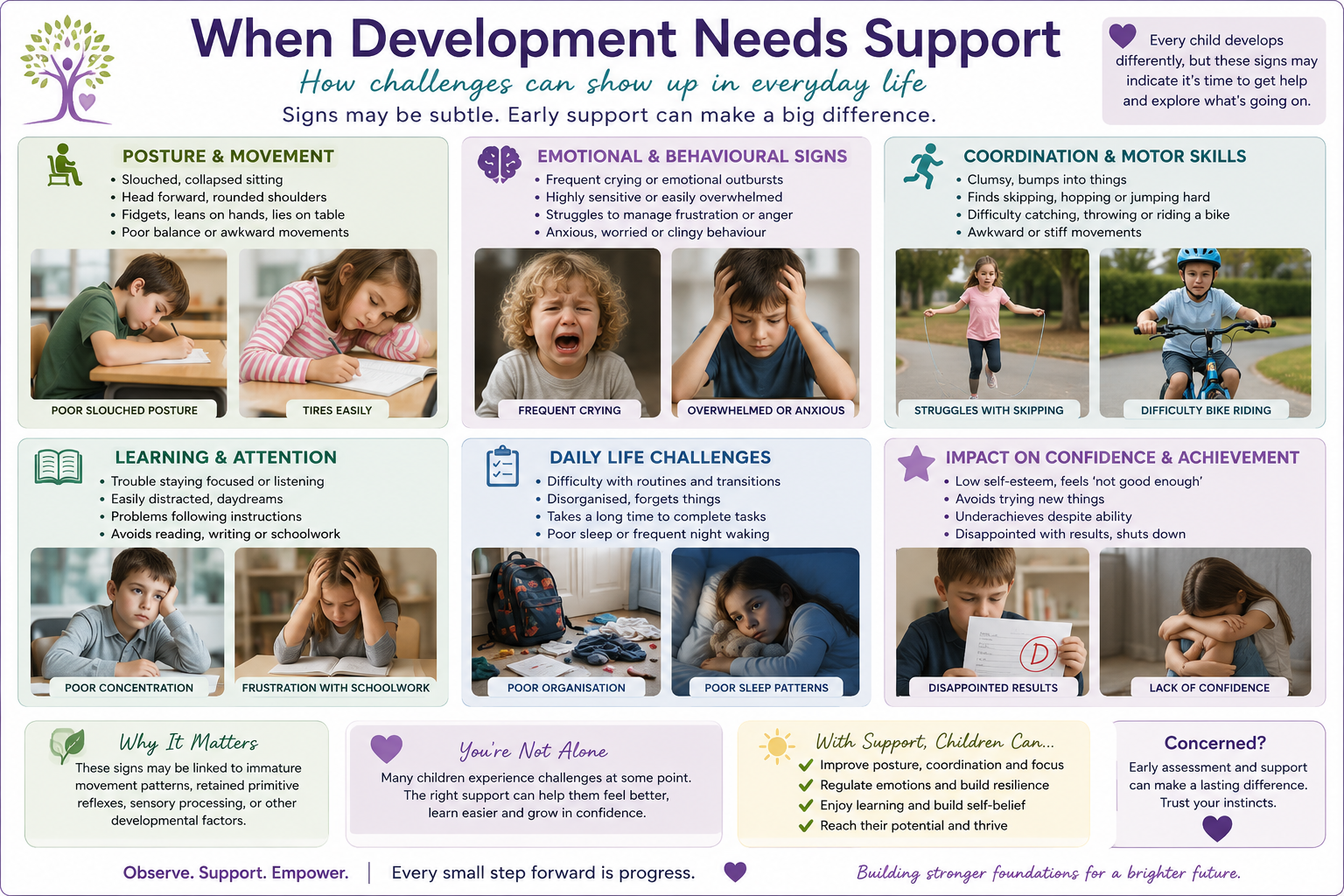
What are primitive reflexes?
Primitive reflexes are automatic movements generated largely through lower levels of the nervous system. They begin before birth and are particularly important during pregnancy, birth and the first months of life.
They help babies with survival and early development, including:
feeding
responding to sudden changes or potential danger
movement
muscle tone
head control
rolling
early coordination
preparation for crawling and walking
As the baby's brain and nervous system mature, these early reflexive responses should become inhibited or integrated into increasingly sophisticated voluntary movement.
In other words, the baby gradually moves from:
automatic movement → controlled movement → increasingly complex movement.
Primitive reflexes should therefore not remain strongly active throughout childhood.
Their persistence beyond the expected developmental period can sometimes accompany developmental or neurological difficulties, although finding a reflex does not, by itself, provide a diagnosis.
Some of the primitive reflexes I may consider
These include:
Moro reflex
The Moro is the baby's automatic startle response.
A sudden movement, sensation of falling, loud sound or other stimulus produces a characteristic whole-body response.
It normally disappears during early infancy.
Persistence of a strong startle-type response later in childhood may accompany difficulties with sensory regulation, movement or neurological development, but anxiety and exaggerated startle responses have many other possible causes.
Asymmetrical Tonic Neck Reflex: ATNR
When a young baby's head turns to one side, the arm and leg on the face side tend to straighten while those on the opposite side flex.
It has sometimes been described as the "fencer's position".
ATNR is important during early development but should become integrated during infancy.
If a strong ATNR pattern persists, it may interfere with:
crossing the body's midline
bilateral coordination
handwriting
eye-hand coordination
some sporting activities
smooth head and arm movements
Symmetrical Tonic Neck Reflex: STNR
STNR develops later than some of the other primitive reflexes and helps the child transition towards crawling on hands and knees.
Movement of the head influences the position of the arms and legs.
It should subsequently integrate as independent control of the head, trunk, arms and legs develops.
A persistent STNR-like pattern may be associated with poor sitting posture, awkward crawling patterns, difficulty coordinating upper and lower body movements and restlessness at a desk.
Tonic Labyrinthine Reflex: TLR
The TLR links head position with changes in muscle tone through the body.
It plays an important role in early postural development.
Persistence may interfere with balance, posture, spatial awareness and smooth coordinated movement.
Spinal Galant reflex
Stimulation beside the spine of a young infant causes the trunk and pelvis to curve towards that side.
It is normally integrated during infancy.
Persistence has been proposed as one possible contributor to excessive fidgeting or sensitivity around the waist and lower back, although these symptoms are not specific to the reflex and require broader assessment.
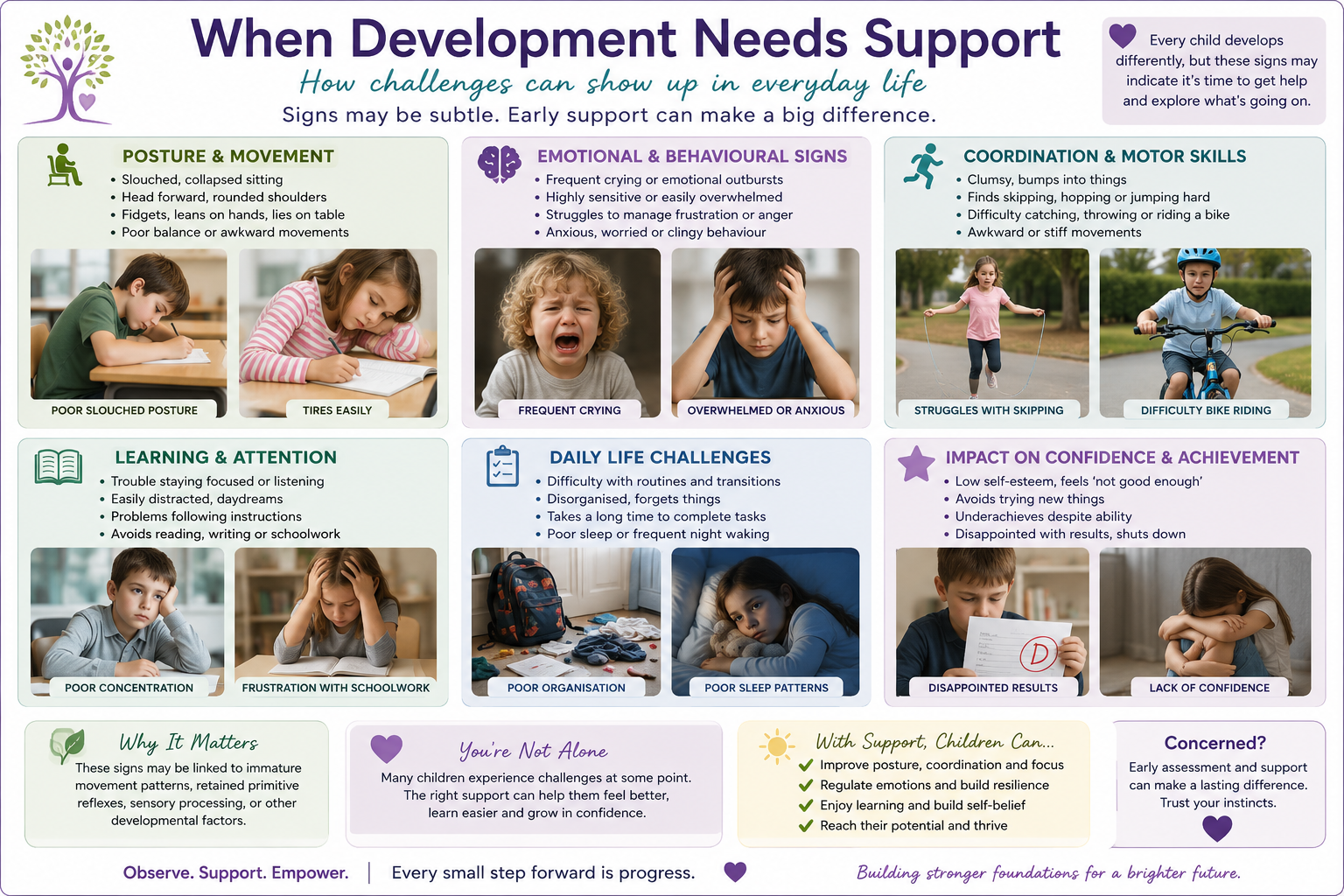
1. Development from 1 to 3 years
This is an astonishing period of neurological development! Really.
The child moves from babyhood into increasing independence.
Walking becomes running. Hands become tools. Language explodes. The child experiments with climbing, throwing, feeding, drawing, building and, inevitably, saying "NO!"
That last one is a developmental milestone parents tend not to celebrate quite so enthusiastically. :-)
Physical and motor development
Across this broad period we expect increasing ability to:
walk independently
run
climb
squat and stand again
kick and throw a ball
negotiate stairs with increasing competence
manipulate toys
stack objects
turn pages
use a spoon
scribble and begin making more purposeful marks
Fine motor control should gradually become more precise.
Movement should also become increasingly symmetrical and intentional.
Communication and cognitive development
Language develops enormously between one and three.
We expect progression from individual words and gestures towards combining words, understanding increasingly complex instructions, naming familiar objects and participating in simple conversations.
Play also becomes increasingly purposeful and imaginative.
Social and emotional development
The toddler begins asserting independence whilst still needing enormous emotional support.
There may be:
separation anxiety
frustration
tantrums
strong preferences
parallel play
increasing imitation
growing awareness of other children
These are not automatically signs that something is wrong.
Primitive reflex considerations
By this age, the major primitive reflexes of early infancy should no longer dominate movement, including:
Moro
ATNR
TLR
Spinal Galant
STNR should also integrate as crawling, standing and walking mature.
When might assessment be sensible?
Seek appropriate professional assessment if a child:
is significantly delayed in walking or other gross motor skills
frequently falls without obvious reason
consistently uses one side significantly more than the other unusually early
has marked stiffness or floppiness
loses a skill they previously possessed
has significant feeding or swallowing difficulties
has substantial speech or communication delay
appears not to hear or respond consistently
has persistent abnormal movement patterns
shows significant difficulty with balance or coordination
has development that simply feels "not quite right" to the parent
Loss of previously acquired developmental skills is particularly important and warrants medical assessment.
2. Development from 3 to 6 years
This is where movement becomes increasingly sophisticated.
Running, jumping, hopping, balancing, climbing, catching and throwing develop alongside increasingly complex language, imagination and social interaction.
Physical development
We expect improving ability to:
run smoothly
jump
hop
stand on one leg
climb
negotiate stairs
catch and throw
use pencils and crayons
manipulate smaller objects
begin dressing independently
By school entry, the child is increasingly able to sit and participate in structured activities, although expecting a five-year-old to behave like a small accountant for six hours is perhaps optimistic.
Cognitive and communication development
Children become increasingly capable of:
telling stories
asking questions
following multi-step instructions
recognising patterns
counting
remembering sequences
imaginative play
learning letters and early reading skills
Primitive reflex considerations
At this stage, primitive reflexes should not dominate normal movement.
If clinically indicated, a trained professional may examine for persistent:
Moro
ATNR
STNR
TLR
Spinal Galant responses
Possible signs warranting further investigation
These can include:
frequent unexplained falling
significant clumsiness
inability to hop or balance when peers can
difficulty catching a ball
marked difficulty crossing the midline
unusual pencil grip combined with other motor problems
considerable difficulty sitting at a table
extreme fatigue from writing or drawing
significant sensory sensitivities
marked speech or language difficulties
difficulty following instructions
persistent toe walking
obvious asymmetry
recurrent headaches
musculoskeletal pain
substantial difficulty keeping up physically with peers
These signs do not automatically mean a primitive reflex is retained. Vision, hearing, neurological development, joint mobility, muscle strength, coordination, neurodevelopmental differences and many other factors may need consideration.
3. Development from 6 to 11 years
School-age development is less dramatic externally than toddler development, but neurologically and physically an enormous amount is happening.
Children refine:
balance
coordination
handwriting
reading
visual tracking
sporting skills
spatial awareness
concentration
emotional regulation
social understanding
organisational abilities
Their nervous system is being asked to perform increasingly complex tasks.
When difficulties become more obvious
A child may have coped perfectly adequately before school.
Then suddenly they are expected to:
sit still,
listen,
look at a board,
copy information,
remember instructions,
write,
read,
filter classroom noise,
coordinate their eyes,
organise their belongings,
and not poke the child sitting beside them.
All simultaneously.
Subtle developmental difficulties can therefore become much more obvious.
Signs worth investigating
These may include:
poor handwriting despite practice
difficulty copying from the board
losing their place when reading
avoiding reading
unusually slow written work
difficulty crossing the midline
persistent poor coordination
frequent tripping
difficulty learning to ride a bicycle
struggling significantly with ball sports
unusual sitting positions
constantly wrapping the feet around chair legs
slumping across the desk
needing to move constantly
headaches associated with schoolwork
neck, shoulder or back discomfort
difficulty sustaining attention
marked sensory overwhelm
significant difficulty following sequences
Primitive reflexes
A strongly evident Moro, ATNR, STNR, TLR or Spinal Galant response would be unexpected at this age and should be considered in the context of the child's complete neurological and developmental picture.
4. Development from 11 to 16 years
And then puberty arrives and rearranges the furniture.
Adolescence produces enormous changes in:
height
body proportions
muscle mass
hormones
sleep
emotional regulation
social awareness
executive function
coordination
A previously beautifully coordinated child can temporarily become surprisingly awkward after a rapid growth spurt.
That does not necessarily indicate pathology.
What should develop?
Teenagers progressively develop:
adult-like coordination
greater strength
improved sporting ability
refined fine motor control
increasingly sophisticated reasoning
greater independence
emotional self-regulation
planning and organisational skills
The brain is, however, still developing.
Signs that deserve attention
These include:
persistent significant clumsiness
unexplained deterioration in coordination
recurrent falls
persistent headaches
dizziness
significant postural problems
recurrent back or neck pain
marked asymmetry
difficulty with handwriting or practical tasks
unusual fatigue
significant difficulty organising movement
new neurological symptoms
loss of previously established abilities
If primitive reflex patterns remain clearly elicitable, this is not something I would dismiss as "just adolescence".
It deserves proper consideration alongside the teenager's neurological, developmental, visual, vestibular and musculoskeletal function.
5. Development from 16 to 21 years
There is a temptation to think development finishes at 16 or 18.
It doesn't.
Brain maturation continues through adolescence and into young adulthood, particularly within networks involved in executive function, planning, judgement, emotional regulation and decision-making.
Physical development may also continue.
By this stage, however, primitive reflexes should certainly not be governing everyday movement.
What might retained developmental patterns look like in a young adult?
Rather than an obvious infant reflex, we may notice functional difficulties such as:
poor coordination
difficulty with bilateral movement
unusual posture
recurrent neck or back tension
poor balance
difficulty with some sports
motion sensitivity
visual tracking difficulties
difficulty maintaining comfortable desk posture
excessive muscular effort during simple tasks
Again, none of these symptoms proves that a primitive reflex is responsible.
The interesting clinical question is:
Why is this young person's body working so hard to perform something that should now be automatic?
That is where assessment becomes valuable.
How are retained primitive reflexes tested?
Primitive reflex testing should ideally form part of a broader clinical examination rather than being treated as a stand-alone home diagnosis.
A clinician may place the person in specific positions or introduce controlled head, limb or sensory movements and observe whether an involuntary motor response appears.
For example:
ATNR assessment
The individual may adopt a controlled position while the examiner slowly turns the head.
The clinician observes whether head rotation produces involuntary movement, loss of position or changes in the limbs or trunk.
STNR assessment
This is commonly examined in a hands-and-knees position.
Controlled flexion and extension of the head is introduced while observing whether the arms, trunk or legs involuntarily change position.
TLR assessment
Balance, posture and changes in muscle tone associated with altered head position may be assessed.
Moro assessment
Rather than deliberately frightening a child, assessment looks at responses to controlled changes in position or sensory stimulation and considers the wider startle response and nervous-system behaviour.
Spinal Galant assessment
In appropriate clinical circumstances, stimulation beside the spine can be used while observing for involuntary lateral trunk or pelvic movement.
These are screening observations, not diagnoses.
The significance depends upon the person's age, response, history and wider examination.
When does a child actually need treatment?
This is perhaps the most important question.
We don't treat a reflex simply because we can find one. We treat the child.
A child should be considered for further assessment when something is interfering with:
comfortable movement
normal development
learning
communication
participation in sport or play
sleep
feeding
independence
physical comfort
everyday family or school life
Treatment will depend entirely upon what the assessment discovers.
Depending upon the child and the underlying problem, appropriate care might involve:
GP or paediatric assessment
paediatric neurology
osteopathic assessment and treatment
physiotherapy
occupational therapy
speech and language therapy
audiology
optometry or ophthalmology
educational or developmental assessment
psychological support
Sometimes several professionals need to work together.
When should you seek medical advice rather than simply treatment?
Certain signs need proper medical investigation.
These include:
loss of previously acquired skills
new weakness
seizures
persistent unexplained headaches
altered consciousness
sudden deterioration in coordination
significant changes in walking
unexplained persistent pain
bowel or bladder changes alongside neurological symptoms
significant feeding or swallowing difficulty
substantial developmental delay
Primitive reflexes should never become an explanation that prevents us looking for something more important.
Development is a journey, not a tick-box exercise
Milestones are enormously useful, but children are human beings rather than instruction manuals.
Development occurs through movement, sensory experiences, relationships, exploration, mistakes, repetition and play.
One delayed milestone does not automatically mean something is wrong.
Equally, persistent parental concern should not simply be brushed aside because a child technically falls within a broad range of "normal".
Parents know their children extraordinarily well.
If something does not look right, feels difficult, has changed or is preventing a child from participating fully in life, it deserves to be explored.
And sometimes the clue is not where we first expect to find it.
Looking at posture, movement, coordination, neurological development and primitive reflexes can provide another piece of that developmental jigsaw.
The objective is not to give a child another label.
It is to understand why they are struggling, what their body and nervous system are doing, and what support will help them move forwards.
Gayle Palmer has over 35 years of specialist paediatric training both at the her original training college - The British School of Osteopathy (no longer operating), the Osteopathic Centre for Children in London and privately.
This article provides general educational information and does not replace individual medical or developmental assessment. If you are concerned about a child's development, particularly if they have lost previously acquired skills or developed new neurological symptoms, seek appropriate medical advice.
To have a paediatric consultation and milestones check up please use THIS LINK to book in to see Gayle.
Please FORWARD this to a friend or family who may find it useful to make a more informed choice for their future. Thank you.
YOUR health IS My Priority. Place your healing in my hands.
Gayle Palmer
Registered Osteopath, Healer, Master NLP practitioner, Hypnotherapist, Advanced Shamanic Practitioner
Copyright 2026 Living Elements Clinic