
What Do Humans Really Need to Be Healthy? The Foundations of Good Health
Health is not an accident! Discover the essential human needs that influence your physical, mental and emotional wellbeing, and what you can do to create a healthier, happier future.
We all want to be healthy, don't we?
Yet when we think about looking after our health, we often focus on just a few things. Eating well, exercising, perhaps taking some vitamins, and visiting a health professional when something starts hurting or stops working properly.
But what do human beings actually NEED to be healthy?
And I'm not talking about simply staying alive. I'm talking about having sufficient energy, feeling comfortable in your body, enjoying relationships, coping with life's challenges and having the freedom to live a life that makes you happy.
After more than 35 years working as an osteopath, I've seen just how interconnected our health really is.
A painful back doesn't always begin with something you've lifted. Poor sleep might be connected to anxiety, discomfort or an unsuitable bedroom. Persistent muscle tension may be influenced by stress, and recovering from an injury can be more challenging when you're exhausted, poorly nourished or isolated.
Our physical, emotional, mental and social health are not separate little boxes. They constantly influence one another.
And this brings me to something I believe passionately:
Health Is Not an Accident!
Good health isn't simply a matter of good luck, although genetics, circumstances and events beyond our control certainly play their part.
Nor is it something we can guarantee by following the perfect diet, doing 10,000 steps a day or buying the latest miracle supplement.
If only it were that easy!
Our health is influenced by the environments we live in, the choices available to us, our daily habits, relationships, resources and how we respond to life's challenges.
Some things we can change relatively easily. Others may require help, planning, money, support or considerable determination.
The important thing is recognising where we have some influence and taking constructive action rather than leaving everything to chance.
So, let's explore the foundations of good health.
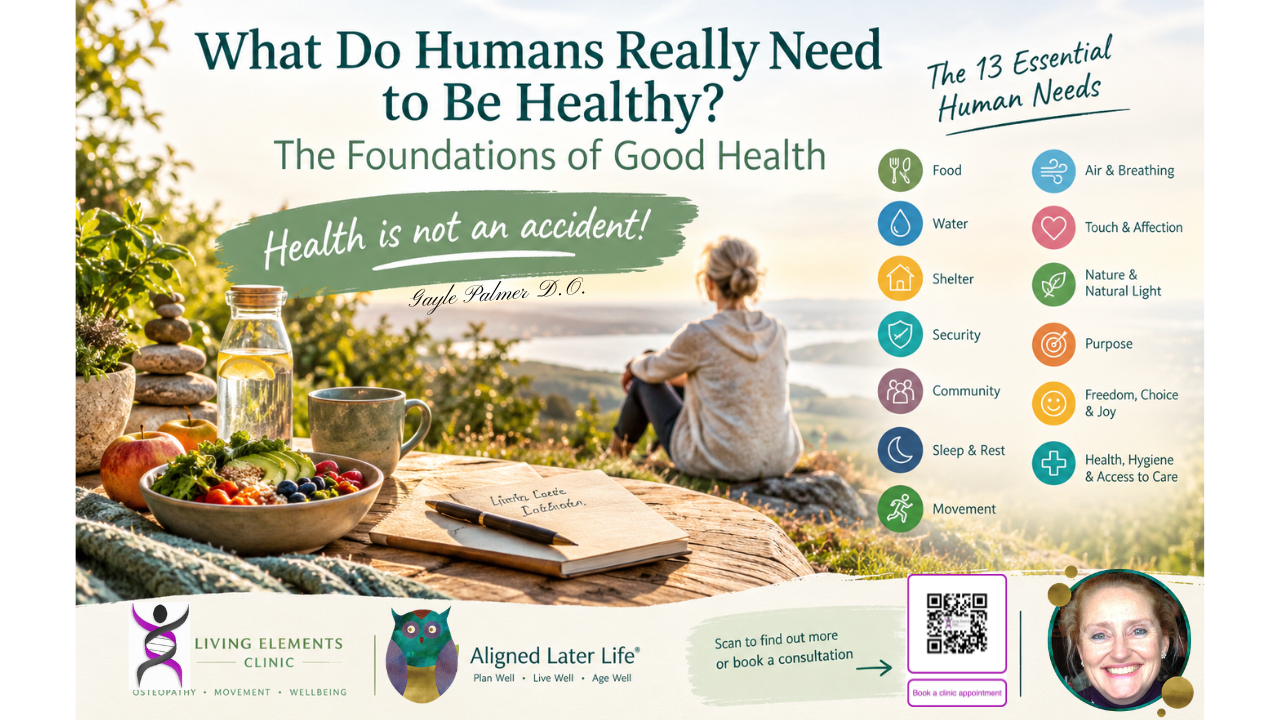
1. Food: Nourishment Is More Than Filling Your Stomach
We all need food to survive, but there's an enormous difference between having enough calories and giving your body the nutrients it needs.
Our bodies require proteins for growth and repair, carbohydrates and fats for energy, and a wide variety of vitamins, minerals and other nutrients to function effectively.
Good nutrition supports our muscles, bones, immune system, brain, digestive health and recovery from illness or injury.
And nutritional requirements can change as we age.
For example, maintaining adequate protein intake becomes particularly important as we get older because we naturally tend to lose muscle mass and strength.
Food also has social and emotional value. Sharing a meal, enjoying familiar recipes and preparing something delicious can contribute to our wellbeing.
Ask yourself: Am I genuinely nourishing my body, or am I simply eating whatever is convenient?
One small action: Add another variety of vegetable, fruit or other nutritious whole food to your meals this week.
2. Water: The Essential We So Often Forget
Water is involved in virtually every process in the body, including circulation, temperature regulation, digestion and the removal of waste products.
Even mild dehydration can affect concentration, energy and physical performance. More significant dehydration can cause dizziness, confusion and serious health problems.
Older adults may be particularly vulnerable because their sensation of thirst can diminish, while some medicines and health conditions can affect fluid balance.
And no, you don't necessarily need to force down litres of plain water every day! Tea, milk and other drinks contribute to hydration, as do water-rich foods.
The amount required varies according to activity, temperature, health and individual circumstances.
Ask yourself: Am I drinking regularly throughout the day, or waiting until I'm desperately thirsty?
One small action: Make fluids easily accessible and develop a routine of drinking regularly, unless you've been medically advised to restrict your intake.
3. Shelter: Is Your Home Supporting Your Health?
Having somewhere to live is a fundamental human requirement.
But a healthy home needs to provide much more than protection from the rain.
Consider the effects of living in a house that's cold, damp, poorly ventilated, cluttered, noisy or difficult to move around.
Such environments may contribute to respiratory problems, stress, poor sleep and increased risks of accidents.
Our surroundings can also influence our mood, concentration and sense of security.
A comfortable, welcoming home doesn't need to be enormous, beautifully decorated or filled with expensive furniture. It needs to work for the people living in it.
As we grow older, this may mean making practical adjustments to lighting, flooring, stairs, bathrooms or furniture.
Ask yourself: Does my home support the way I want to live, or am I constantly having to work around its limitations?
One small action: Choose one area of your home that could be healthier, safer or more comfortable and make one improvement.
Free resource: My Your Sanctuary Checklist: Creating a Home That Heals is available through Aligned Later Life. It encourages you to look at your home with fresh eyes and consider how it can better support your wellbeing.
4. Security: Feeling Safe Matters More Than You Might Think
Human beings need a degree of safety and stability.
This includes physical security, emotional safety, financial stability and confidence that essential needs can be met.
When we feel threatened or overwhelmed, our body's stress-response systems become more active.
This is useful in genuine emergencies. However, prolonged stress can affect sleep, concentration, digestion, muscle tension and mental health.
Financial worries, difficult relationships, uncertainty about the future or feeling unsafe at home can all contribute to ongoing stress.
Security also means knowing where important information is kept, whom to contact in an emergency and what arrangements are in place if something unexpected happens.
You cannot remove every uncertainty from life, but you can often reduce unnecessary ones.
Ask yourself: What is currently making me feel unsettled, vulnerable or insecure?
One small action: Identify one practical concern you've been avoiding and take the first step towards resolving it.
Free resources: At Aligned Later Life, my Later Life Assessment helps you consider how prepared you are across important areas of life, while the Medical History Form helps organise essential health information for yourself and those who may need to support you.
Being organised isn't particularly glamorous, but it can be enormously reassuring!
5. Community: We Are Not Designed to Do Everything Alone
Human beings are social creatures.
Throughout history, belonging to a group has provided protection, cooperation, practical assistance and emotional support.
Today, relationships remain an important influence on physical and mental health.
Research has linked loneliness and social isolation with an increased risk of several health problems, including depression, cardiovascular disease and cognitive decline.
And you don't have to live alone to feel lonely.
Some people are surrounded by others yet feel deeply disconnected. Others enjoy considerable time on their own while maintaining a small number of meaningful relationships.
It's the quality of our connections that matters, not simply how many people we know.
Friendship, family, neighbours, clubs, community groups and shared interests can all provide opportunities for connection.
Ask yourself: Do I have people I can share both my good news and my difficult moments with?
One small action: Reconnect with someone, arrange a coffee or explore a local activity that genuinely interests you.
At Aligned Later Life, I also explore the importance of relationships, communicating wishes and supporting family members without taking away their independence.
6. Sleep and Rest: Your Body Needs Time to Recover
Sleep is not an optional luxury.
While we sleep, our bodies and brains undertake essential processes involved in memory, immune function, hormonal regulation and physical recovery.
Poor sleep may influence our mood, concentration, pain sensitivity and ability to cope with everyday challenges.
And sleep isn't quite the same as rest.
You may get enough hours in bed but still feel exhausted because your days are overloaded, mentally demanding or emotionally draining.
Rest might involve sitting quietly, reading, spending time outdoors, enjoying a hobby or simply allowing yourself to stop.
Without feeling guilty!
Ask yourself: Am I giving myself enough opportunity to recover, physically and mentally?
One small action: Create a more consistent bedtime routine and introduce a short period of genuine rest during your day.
7. Movement: Your Body Was Built to Be Used
Our bodies are designed for movement.
Muscles need to work to maintain strength. Joints benefit from appropriate movement. Our balance, coordination, cardiovascular health and independence all depend, to varying degrees, on remaining physically active.
Yet modern life makes it remarkably easy to spend much of the day sitting.
And as we get older, there can be a gradual tendency to do less, particularly if pain, stiffness or fear of falling becomes a concern.
Unfortunately, doing less can sometimes lead to further loss of strength, mobility and confidence.
Movement doesn't have to mean running marathons or becoming a gym enthusiast.
Walking, gardening, dancing, swimming, stretching and strength or balance exercises can all have value.
The important thing is finding activities that are appropriate, enjoyable and sustainable.
Ask yourself: Am I maintaining the movement and strength I'll need to continue doing the things I love?
One small action: Add a little more comfortable movement to your daily routine. If pain or mobility problems are limiting you, seek appropriate professional advice.
At Living Elements Clinic near Chichester, I work with people of different ages to assess musculoskeletal problems, support mobility and develop realistic approaches to improving physical function. To book an appointment go to: bit.ly/osteogayle
8. Air and Breathing: An Invisible Foundation of Health
We can survive for some time without food, and considerably less time without water, but our need for oxygen is continuous.
Breathing seems wonderfully automatic, which is probably why we so often overlook it.
The quality of the air we breathe matters too.
Air pollution, cigarette smoke, damp environments and certain indoor pollutants can affect respiratory health.
Our breathing patterns may also change with pain, physical exertion, anxiety or stress.
Spending time outdoors, improving ventilation where appropriate, and reducing exposure to pollutants can all contribute to healthier breathing environments.
Ask yourself: How healthy is the air in the places where I spend most of my time?
One small action: Consider how you could improve indoor air quality or spend more time in cleaner outdoor environments.
9. Touch and Affection: The Importance of Human Contact
Touch is one of our earliest ways of experiencing the world.
From infancy onwards, appropriate, welcome physical contact can provide comfort, reassurance and a sense of connection.
A hug from someone we love, holding hands or having a reassuring hand placed on our shoulder can carry enormous emotional meaning.
However, people's needs and preferences for touch vary considerably, and consent and personal boundaries are essential.
Some people, particularly those who are bereaved, isolated or living alone, may have very little physical contact with others.
We should never assume everyone wants touch, but neither should we overlook its importance for those who do.
Ask yourself: Do I have enough warmth, affection and meaningful physical connection in my life?
One small action: Think about the forms of connection that feel comfortable and supportive to you, and how you might nurture them.
10. Nature and Natural Light: Reconnecting With the World Around Us
We are part of the natural world, not separate from it.
Natural daylight helps regulate our sleep-wake cycle, while access to green spaces may support physical activity, relaxation and psychological wellbeing.
Nature offers opportunities to move, observe, connect and find pleasure in the simplest things.
You don't need access to acres of countryside.
A garden, local park, beach, window box or favourite tree can all provide moments of connection.
And sometimes a few minutes watching the birds is far more restorative than another twenty minutes scrolling through your phone.
Ask yourself: How much meaningful contact do I have with nature each day?
One small action: Spend ten minutes outdoors, paying attention to what you can see, hear and feel.
11. Purpose: We Need Reasons to Get Out of Bed
Once our immediate physical needs are met, something else becomes increasingly important.
Meaning.
Having a sense of purpose can provide motivation, direction and a feeling that our lives matter.
For some people, purpose comes from work or raising a family. For others, it's caring for animals, helping neighbours, gardening, volunteering, learning, creating or sharing their knowledge.
Our sense of purpose may change dramatically throughout life.
Retirement, bereavement, illness or changes in family circumstances can leave people wondering what their next chapter should look like.
And there's no rule that says your purpose has to be enormous or world-changing!
Sometimes it simply means having something worthwhile to look forward to.
Ask yourself: What makes me feel useful, fulfilled or genuinely alive?
One small action: Revisit something you've always wanted to learn, create or experience.
My Foundations for an Aligned Later Life® Masterclass Series explores values, health, financial clarity, happiness and purposeful action, helping you create greater direction for the years ahead.
12. Freedom, Choice and Joy: Are You Living or Merely Existing?
We all need some degree of autonomy.
Being able to make choices about our lives, express preferences and participate in decisions that affect us is important for dignity and wellbeing.
This is particularly relevant as people grow older or begin to require support.
It's easy for well-meaning relatives or carers to start making decisions on someone's behalf, believing they are being helpful.
Yet removing someone's choices unnecessarily can undermine their confidence and sense of identity.
And then there's joy.
Laughter, play, creativity, affection, exploration and doing things simply because we enjoy them.
These aren't necessarily essential for immediate survival, but they can make an enormous difference to our experience of living.
Ask yourself: When did I last do something purely because it made me happy?
One small action: Make room for something you enjoy this week, without feeling that you need to justify its usefulness.
Through Aligned Later Life, I encourage people to think not only about what needs organising for the future, but also about the life they actually want to create and enjoy NOW.
13. Health, Hygiene and Access to Appropriate Care
Even when we do our best to support our health, illness and injury can still happen.
Having access to clean water, sanitation, suitable hygiene facilities, preventive healthcare and timely medical advice makes a substantial difference to health outcomes.
This is also where recognising problems early becomes important.
Persistent pain, unexpected changes in health or symptoms that are worsening should not simply be accepted as an inevitable part of getting older.
Nor should we assume that every symptom can be resolved through diet, exercise or lifestyle changes alone.
Sometimes we need medical investigations, medication, rehabilitation, specialist care or a combination of approaches.
Ask yourself: Am I taking reasonable care of my health, and do I know when to seek help?
One small action: Check whether your health records, medication list and emergency contacts are accurate and accessible.
Free resource: The Medical History Form, available through Aligned Later Life, is a useful starting point for organising important information, especially if you or a family member needs help in an emergency.
The Bigger Picture: Everything Is Connected
Let's imagine two people with the same painful neck.
One works at a desk, sleeps well, enjoys supportive relationships, eats a varied diet and has time to exercise.
The other is caring for an elderly parent, worrying about finances, sleeping poorly, missing meals and feeling isolated.
They may have similar symptoms, but their circumstances are very different.
Both deserve an individual assessment, and neither person's pain should be dismissed as simply stress-related.
However, looking at the bigger picture may help reveal factors contributing to their discomfort or making recovery more challenging.
This is one of the reasons I've always valued a whole-person approach to healthcare.
As an osteopath, I don't just want to know where something hurts. I want to understand how the problem is affecting your life and what else might be relevant to your health.
Sometimes treatment is an important part of the solution.
Sometimes changes in movement, rest, work habits or daily routines may help.
And sometimes the most useful next step is recognising that another aspect of life needs attention.
Good health is rarely the result of one isolated action. It is supported by many different factors working together.
From Understanding Your Health to Creating Your Future
This whole-person perspective also inspired me to create Aligned Later Life.
Over decades of working with patients, I've seen that many concerns extend far beyond physical symptoms.
People worry about their future independence, their homes, financial security, relationships, ageing parents, health decisions and what might happen if they become unable to manage everything themselves.
Often these concerns remain unspoken or are put off until something forces a decision.
But why wait for a crisis?
Aligned Later Life offers practical guidance, free resources, workshops and programmes to help individuals and families take a more thoughtful and organised approach to the future.
And despite the name, later life planning isn't just for older people.
The decisions we make in our thirties, forties, fifties and sixties can influence the opportunities and choices available to us in later decades.
You can begin with one of my free resources:
Later Life Assessment: Explore how prepared you are across the important areas of your life and identify what needs attention.
Your Home Sanctuary Checklist: Consider whether your home is helping you feel comfortable, secure, supported and inspired.
Medical History Form: Organise essential health information for yourself and those who may need to support you.
Hospital Bag Checklist: Prepare important belongings and information before a hospital stay becomes an urgent necessity.
These are practical starting points, not another enormous to-do list!
And if you want to explore your future in greater depth, the Foundations for an Aligned Later Life® Masterclass Series guides you through your values, health, wealth, happiness and next steps.
Your Health Is Worth More Than Good Intentions
There's a very big difference between knowing what might help and actually doing something about it.
Most of us know we should eat well, move regularly, sleep properly and manage stress.
Yet life gets busy.
We put everyone else's needs first.
We promise ourselves we'll make changes next week, next month or when things quieten down.
And sometimes we only start paying attention when something goes wrong.
But health is not an accident!
It is influenced by the foundations we build and maintain throughout our lives, alongside the circumstances we cannot always control.
You don't need to tackle every aspect at once.
In fact, trying to change everything overnight is often a very effective way of changing absolutely nothing!
Instead, choose one area where a small improvement could make a meaningful difference.
Perhaps it's drinking more regularly, getting better sleep, arranging that overdue appointment, reconnecting with a friend or making your home a little safer.
One positive action can lead to another. And another...
That's how lasting changes begin.
So, What Does YOUR Body and Life Need Right Now?
Before you leave this article, take a moment to consider three questions:
Which of these basic human needs am I supporting well?
Which need have I been neglecting, overlooking or struggling to meet?
What ONE action could I take this week to improve things?
Your answers may surprise you.
You might discover that the most useful thing for your wellbeing isn't another supplement, a new fitness gadget or a complicated health regime.
It might be getting more sleep, asking for help, finding companionship or finally dealing with something that's been worrying you.
Whatever your starting point, remember:
Good health is not just the absence of illness. It is about creating the conditions in which our bodies, minds and lives can function at their best.
And the future isn't something we simply have to wait for.
It's something we can help shape, starting today.
To a healthier, happier and more fulfilling life,
Gayle Palmer D.O.
Registered Osteopath, Living Elements Clinic
Founder of Aligned Later Life®
www.livingelements.co.uk
www.alignedlaterlife.com
This article provides general health and wellbeing information and does not replace individual medical advice or assessment.